Fossil (1999): The Smallest Set With the Longest Shadow
Sixty-two cards, one skeletal Aerodactyl hand for a symbol, and the last Starlight Holofoil ever printed. Twenty-seven years on, Fossil still sets the terms.
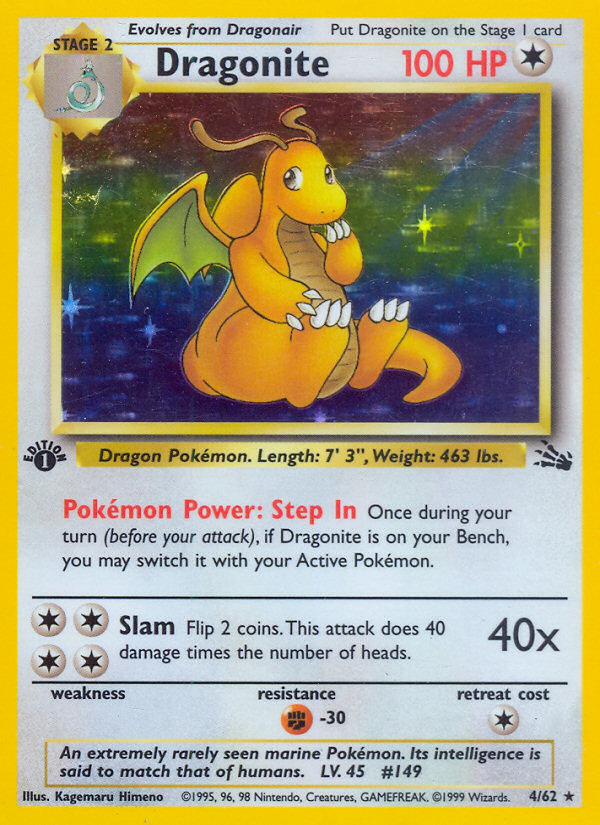
Dragonite — Fossil #4/62, the set's flagship holo.
Fossil is the smallest set in the history of the Pokémon TCG, and it is the one collectors argue about the most. Sixty-two cards. That is the whole set — fewer than any other standard expansion ever printed — and it still contains Dragonite, Gengar, the three Legendary Birds, Ditto, and a Psyduck with a headache that has outlasted the entire franchise's first era.
The facts first. Fossil was the third expansion of the Pokémon Trading Card Game, released in English on October 10, 1999, by Wizards of the Coast. In Japan it was called Mystery of the Fossils and had been out since June 21, 1997. Its symbol is the skeletal hand of an Aerodactyl. Its name comes from the fossil Pokémon — Omanyte, Kabuto, and Aerodactyl, the ones you resurrect from fossils in the games. It followed Jungle and was followed by Team Rocket, which means it sits exactly at the hinge of the original series: after the TCG proved itself, before it got dark.
The set's fifteen holos read like a greatest-hits list of the first 151: Aerodactyl, Articuno, Ditto, Dragonite, Gengar, Haunter, Hitmonlee, Hypno, Kabutops, Lapras, Magneton, Moltres, Muk, Raichu, and Zapdos. Dragonite at #4 is the flagship — the first time the gentle giant appeared as a holo, and still the card people picture when they think of Fossil. But the set's personality lives in the commons and uncommons too: the first Haunter, the first Hypno, and Psyduck at #53, a common whose entire identity is a headache that never goes away.
There is one footnote about Fossil that matters more than any card in it. Fossil was the final expansion to use Starlight Holofoil — the sparkle pattern on the holo cards, a scatter of tiny stars across the art. After Fossil, the holo pattern changed, and the Starlight look never came back. Collectors can spot a Fossil holo across a room by that pattern alone. It is the set's fingerprint, and it is why even played copies of Fossil holos get a second look.
Fossil also shipped with two theme decks, BodyGuard and LockDown, for players who were still learning the game in 1999 — which was nearly everyone. The TCG was nine months old in English. People were still figuring out what a Trainer card was. Fossil's Headache attack, on our Psyduck, literally stopped opponents from playing Trainers. The set was teaching the game as it went.
Why does any of this matter in 2026? Because Fossil is where the TCG's visual language settled. The first two sets were experiments; Fossil is the first one that looks like the game we still play — same layout, same energy costs, same rhythm, with the art doing the talking. And because the set is small, it is completable in a way the modern 200-card sets aren't. Sixty-two cards, fifteen holos, and a story you can hold in one binder.
It is also, not incidentally, the set our showcase leads with. Our Fossil Psyduck — the card at the top of the shop — is $255, priced at 50% of its $510 PSA 10 value, because that figure has no graded-sales evidence behind it yet. It is a common, from the smallest set ever made, and it is the most expensive card we list. That is what Fossil does: it makes the small things matter.